At Charlotte Water’s McAlpine Creek Wastewater Management Facility Nutrient Harvesting project, one piece of equipment defines the future building: the nutrient harvesting reactor.
Weighing approximately 50,000 pounds, the steel vessel is the largest and most technically challenging component on the project. Its size, weight, and final location meant it could not be installed through a completed roof or added later through a small opening. The reactor had to be set first, with the building constructed around it.
Once operational, the reactor will help Charlotte Water recover nutrients from wastewater and convert them into a solid product that can be used as fertilizer. The process turns nutrients that can create treatment and maintenance challenges into a usable resource.
Supporting Nutrient Recovery at McAlpine Creek
The nutrient harvesting system is designed to capture nutrient-rich sidestream flows within the treatment process. Inside the reactor, controlled conditions promote crystal formation, producing a solid material such as struvite or a similar nutrient-based product.
Recovering these nutrients before they continue through the facility can help reduce scaling in pipes and equipment, limit unplanned maintenance, and reduce the amount of downstream treatment required. It also supports Charlotte Water’s broader nutrient management and environmental performance goals while creating a product with the potential to offset operating costs.
Reactor Installation Process
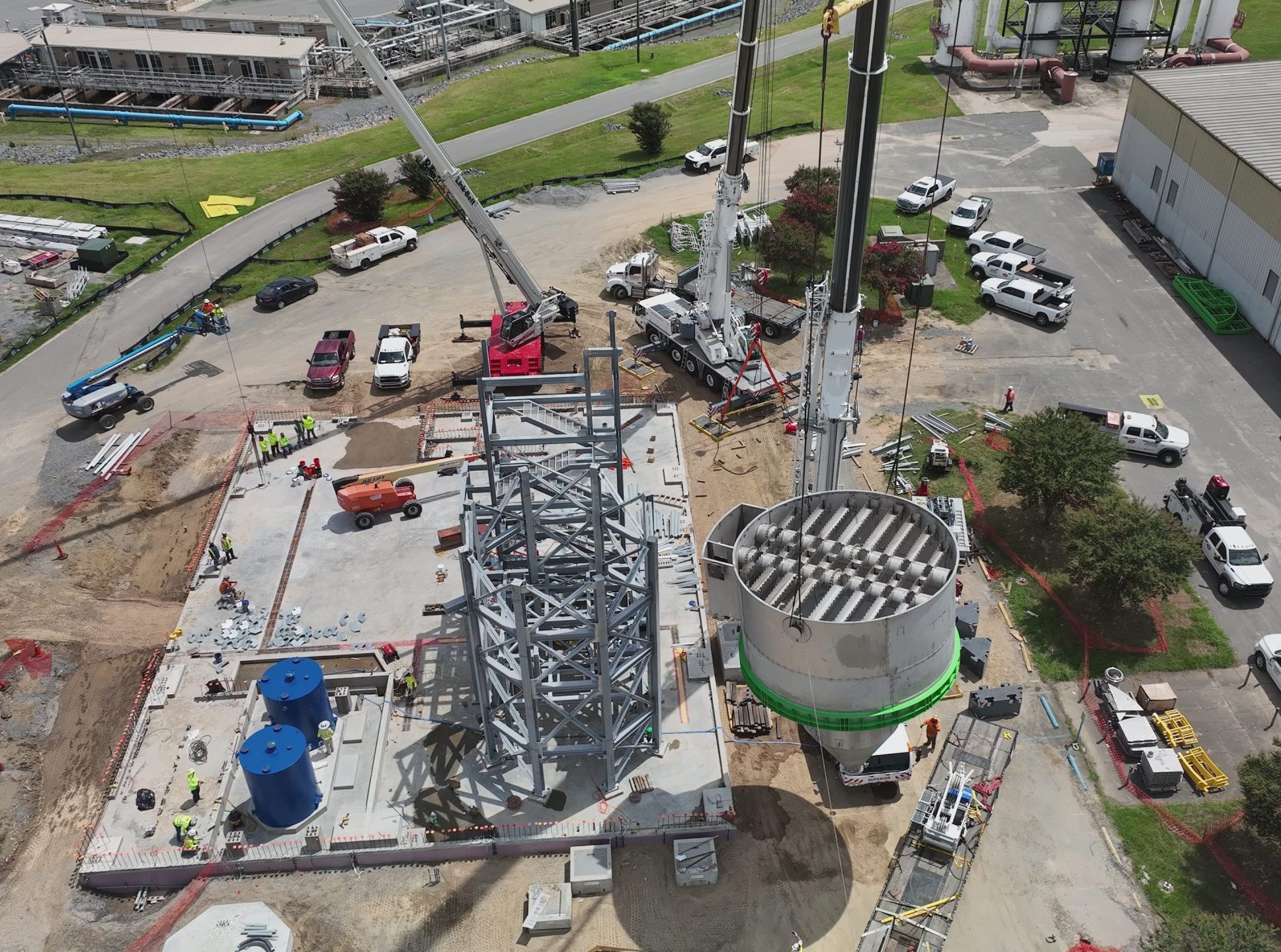 The reactor was fabricated upside down and had to be flipped, rotated into its final orientation, and set on support columns within tight tolerances. Its supports, nozzles, and attached weir box also had to align with the surrounding steel and process layout.
Before the lift, the team installed a full-size steel template matching the reactor’s footprint and orientation. This allowed the support columns’ locations, elevations, and alignment to be checked before the vessel was overhead. The building steel and panels were already staged on site, but erection could not move forward until the reactor was set.
Flipping and Setting the 50,000-Pound Vessel
A 300-ton crane served as the primary lifting unit, while a 120-ton crane assisted with flipping, rotating, and controlling the vessel. Working in tandem, the cranes moved the reactor into position and lowered it onto the support columns.
The attached weir box affected the reactor’s balance during the pick, making orientation and alignment more sensitive. One column required a final adjustment while the vessel remained supported by the cranes. The team completed the adjustment and safely set the reactor in its final position.

 >
>
 >
>
 >
>